TRAINING METHODOLOGY
PRINCIPLES OVER TECHNIQUES
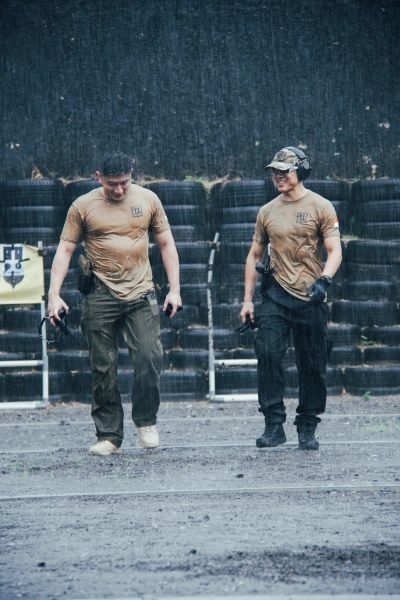
T1 Combatives is built around the belief that effective training should develop adaptable principles rather than dependence on fixed sequences of techniques.
Real confrontations are unpredictable. The opponent, environment, available weapons, equipment and tactical objective can all change the problem in an instant. Rather than attempting to memorise a specific response for every possible situation, we develop fundamental skills and concepts that can be applied across different circumstances.
Our methodology combines lessons drawn from Special Operations experience, martial arts and combat sports, Kinetic Fighting – Integrated Combatives, and continued pressure testing through training and competition.
The objective is not simply to know more techniques.
It is to develop individuals who can recognise problems, adapt and perform under pressure.

THE FIVE PRINCIPLES OF KINETIC FIGHTING
An important foundation of T1's combatives methodology comes from Kinetic Fighting – Integrated Combatives (KEF-IC), developed by former Australian Special Forces soldier Paul Cale.
Rather than relying on an ever-expanding catalogue of techniques, Kinetic Fighting is underpinned by fundamental principles that can guide decision-making throughout a physical confrontation.
01 — MAINTAIN YOUR BALANCE
Before you can effectively control another person, strike, access a weapon or disengage, you must first maintain your own ability to operate.
Balance is more than simply remaining on your feet. It includes posture, base, positioning and the ability to generate or redirect force while another person is actively attempting to disrupt you.
Control yourself before attempting to control someone else.
02 — BREAK YOUR OPPONENT'S BALANCE
Once your own position is established, disrupting the opponent's posture and structure reduces their ability to effectively attack, defend or access weapons.
This principle appears throughout wrestling, Judo, Jiu-Jitsu and other grappling systems and remains fundamental within combatives.
Breaking balance creates opportunities for control, takedowns, strikes, restraint, disengagement or transition to other tactical options.
03 — MAINTAIN MOVEMENT
A fight is dynamic. Remaining static allows an opponent to regain posture, create space, access weapons or change the situation.
Movement can be used to create angles, improve position, generate pressure, deny access to weapons and continuously force the opponent to react.
The objective is not movement for its own sake, but purposeful movement that continually improves the tactical situation.
04 — MAKE FULL USE OF ANY AVAILABLE WEAPON
Combatives does not exist separately from weapons.
Depending on the operational context, weapons may include firearms, edged weapons, less-lethal options, equipment, environmental objects or other available tools.
The presence of a weapon fundamentally changes priorities. Training must therefore develop awareness of weapon access, retention, deployment, denial and integration rather than treating unarmed fighting as an isolated problem.
05 — CONTROL THE HEAD / DOMINATE THE THROAT
The head strongly influences posture, orientation and the body's ability to generate effective force.
Controlling the head—and, where appropriate to the operational context, dominating the throat—can provide significant mechanical control over an opponent's posture and movement.
This principle is reflected throughout T1's clinch work, grappling, takedowns and positional control, where effective head positioning and control can greatly influence the outcome of a physical engagement.

HOW T1 TRAINS
The principles provide the foundation. The training methodology determines whether they can actually be applied.
T1 develops these skills through several interconnected concepts.
SYSTEMS & CONCEPTS
We prioritise understanding why something works, rather than simply memorising what to do.
Techniques remain important, but they are examples of how underlying principles can be applied.
When circumstances change, a memorised sequence may fail. Understanding balance, leverage, positioning, pressure, distance and control gives the practitioner the ability to adapt.
The technique may change. The principle remains.
COMBAT SPORTS AS A FOUNDATION
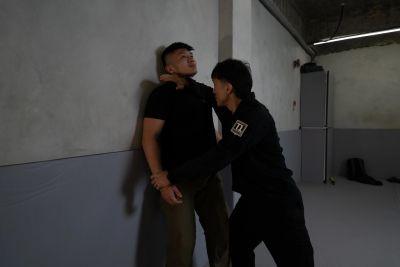
T1 strongly believes in the value of combat sports.
Brazilian Jiu-Jitsu, Judo, Wrestling, Boxing, Muay Thai and other competitive fighting systems provide something extremely valuable: regular exposure to opponents who are actively trying to prevent your techniques from working.
Sparring and competition develop timing, balance, pressure, composure, decision-making and the ability to solve physical problems against genuine resistance.
However, combat sports and operational combatives do not share identical objectives.
Rules, weapons, equipment, teammates, environments and operational requirements change the context.
Our approach is therefore not to reject combat sports, but to take the attributes and skills developed through them and adapt their application to the tactical environment.
PROGRESSIVE RESISTANCE
Skills must eventually survive resistance.
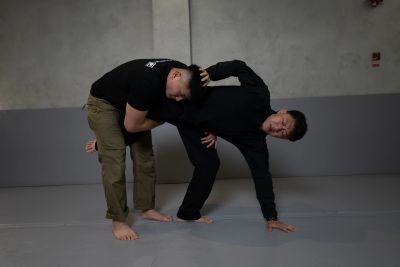
T1 training progresses from understanding the mechanics of a skill to applying it against increasingly realistic opposition.
LEARN → APPLY → RESIST → INTEGRATE
Participants first develop the movement and underlying concepts in a controlled environment.
Resistance is then progressively introduced.
As proficiency increases, the opponent gains greater freedom to resist, counter and create unpredictable problems.
Eventually, skills are integrated into scenarios where participants must determine what to do rather than simply demonstrate something they already know is coming.

PRESSURE TESTING
A technique that works only when the training partner cooperates provides limited information about whether it can function during an actual confrontation.
For this reason, pressure testing is central to T1's methodology.
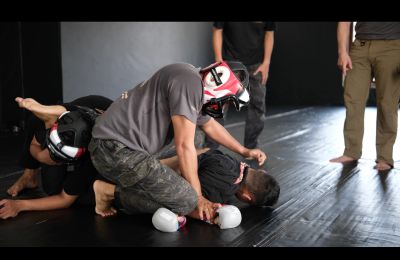
Training should eventually involve opponents who can resist, counter, move unpredictably and attempt to impose their own objectives.
Failure during training is not something we attempt to eliminate. It provides information.
It exposes weaknesses in technique, positioning, decision-making and sometimes the methodology itself—allowing those weaknesses to be identified and refined before they matter.
IF YOU CAN'T DO IT UNDER PRESSURE, YOU DON'T HAVE IT.
CONTEXT CHANGES EVERYTHING
A technique cannot be judged independently of the environment in which it will be used.
Something effective in a grappling competition may require modification when firearms, edged weapons, body armour, confined spaces, teammates or operational objectives are introduced.
T1 therefore considers factors such as:
WEAPONS
EQUIPMENT
ENVIRONMENT
TEAMMATES
DISTANCE
FORCE OPTIONS
OPERATIONAL OBJECTIVES
The fundamental mechanics of fighting may remain familiar.
The priorities change with the context.
TACTICAL INTEGRATION
Combatives is only one part of the tactical problem.
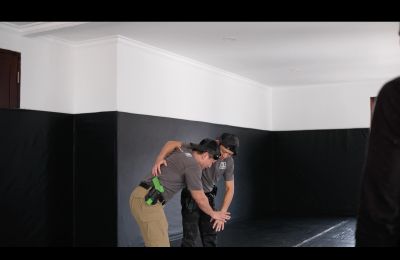
An operator may need to transition between controlling another person, protecting or accessing a weapon, creating distance, employing a force option, communicating with teammates or returning to the wider tactical problem.
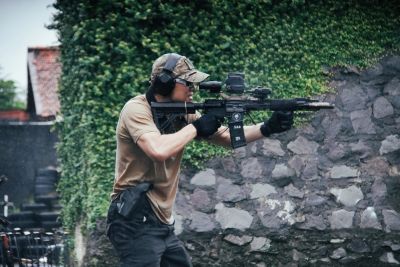
For this reason, T1 progressively integrates combatives with weapon retention and access, firearms, team tactics, CQB and scenario-based decision-making.
The objective is not simply to produce someone who is good at fighting.
It is to develop someone capable of using physical fighting skills without losing sight of the wider tactical objective.
ALWAYS EVOLVING
T1 does not believe that any methodology should remain unchanged simply because "this is how it has always been done."
Our Special Operations experience provides context. Martial arts and combat sports provide a pressure-tested foundation. Kinetic Fighting provides an internationally developed framework for integrated combatives. Training military and law-enforcement personnel exposes us to different operational requirements and problems.
And continued training and competition keep our own abilities and assumptions under pressure.
We take lessons from each.
We test them.
We retain what works and continue refining what can be improved.
Because methodology should never become more important than the objective it was created to achieve.
SYSTEMS AND CONCEPTS.
REAL RESISTANCE.
PROVEN UNDER PRESSURE.