About T1 Combatives

Built from Special Operations experience. Refined through martial arts.
Founded by former Special Operations personnel from Singapore Armed Forces' Special Operations Force (SOF), T1 combines operational experience with martial arts and combat sports to develop practical, pressure-tested tactical training.
Our story
BUILT FROM EXPERIENCE. PROVEN UNDER PRESSURE.
T1 Combatives began with a simple belief: combatives should be built around what works under resistance, not what looks good in demonstration.
The foundations of T1 were shaped during founder Jimmy Ang’s time in Singapore’s Special Operations Force (SOF), where he served as an operator and was subsequently appointed Head of Combatives.
During his time in that role, Jimmy worked to evolve the unit’s approach to unarmed combat. Greater emphasis was placed on grappling, control and pressure-tested fighting skills, while accounting for the realities of an operational environment—where weapons, equipment, teammates and tactical objectives fundamentally change the context of a physical confrontation.
After leaving the Special Forces, Jimmy wanted to continue developing these ideas outside the military and build a training organisation around them.
He approached his former SOF teammate Kevin, who had been recognised within the unit as one of its more accomplished martial artists. Kevin also brought significant operational and leadership experience from his time as a Detachment Commander within SOF. After leaving the force, he continued pursuing his passion for martial arts, drawing from experience across multiple disciplines while also teaching Jiu-Jitsu and fitness.
The two shared a similar belief: martial arts and combat sports provide an invaluable foundation for fighting, but applying those skills within a military or law-enforcement environment requires a deeper understanding of combatives as an integrated tactical discipline.
LOOKING BEYOND OUR OWN EXPERIENCE
Having the idea and a strong martial arts foundation was only the beginning.
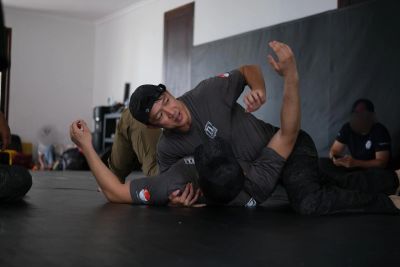
Jimmy and Kevin did not want T1 to be built solely around their own experiences or assumptions. They wanted to understand how established combatives programmes were being developed and implemented internationally, particularly within countries with extensive military and Special Operations experience.
That search brought them to Australia and Paul Cale, a former Australian Special Forces soldier and the founder of Kinetic Fighting – Integrated Combatives (KEF-IC), and also the founder of Australia and New Zealand Army's modern combatives.
Jimmy and Kevin travelled to Australia to train directly within the Kinetic Fighting system, seeking to deepen their understanding of how combatives was structured, taught and integrated within military and law-enforcement environments internationally.
The experience helped broaden T1's perspective beyond individual fighting skills. Combatives was not simply about striking, grappling or learning a collection of techniques. It had to exist within a much larger tactical framework—accounting for weapons, equipment, teammates, environment, mission and the operational objectives of the end user.
Their training with Paul became an important part of T1's development and led to an ongoing affiliation with Kinetic Fighting, connecting T1 with an internationally established military and law-enforcement combatives methodology while continuing to develop an approach relevant to the organisations and environments we work with.
PRESSURE TESTED FROM THE BEGINNING
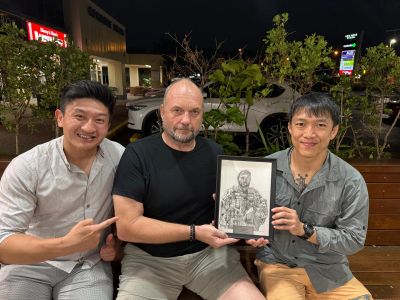
T1's approach was challenged early in its development.
The emphasis we placed on grappling within combatives differed from some of the more traditional approaches to military unarmed combat at the time. Rather than debating which methodology was superior in theory, we welcomed the opportunity to put our ideas to the test through live, resistant training.
That experience reinforced one of the principles that continues to define T1 today:
If you can't do it under pressure, you don't have it.
We believe training should be questioned, tested and continuously refined. No technique or methodology should be accepted simply because it has always been taught that way.
FROM COMBATIVES TO TACTICAL TRAINING
What began with combatives has continued to evolve.
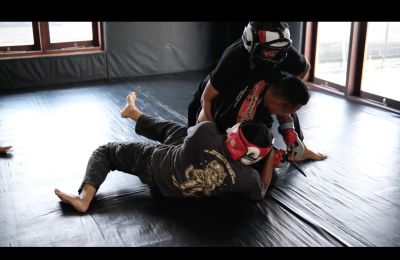
Combatives remains T1's core specialisation, but fighting rarely exists in isolation within an operational environment. Weapons, firearms, confined spaces, equipment, teammates and tactical objectives can fundamentally change how a problem must be solved.
T1's capabilities have therefore expanded into complementary disciplines including firearms, Close Quarters Battle (CQB) and tactical integration, while maintaining the philosophy on which the company was founded: practical skills, adaptable concepts and training that can withstand genuine resistance.
Since our beginnings, T1 has had the opportunity to train military, law enforcement and specialised operational personnel both in Singapore and overseas, continually exposing our methodology to different requirements, environments and perspectives.
ALWAYS EVOLVING
T1 was never intended to become a fixed collection of techniques.
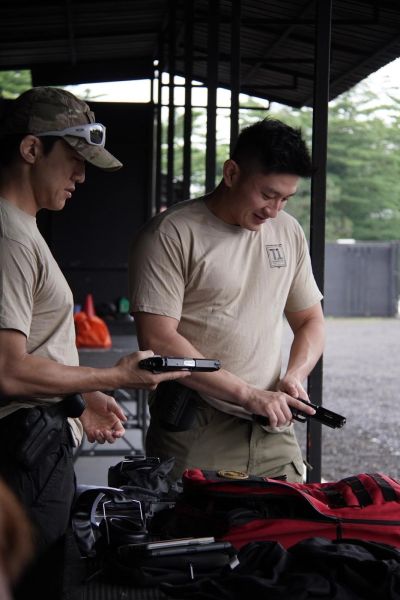
Our Special Operations experience gave us the context. Martial arts and combat sports gave us the foundation. Our development with Kinetic Fighting broadened our understanding of combatives as an integrated tactical discipline. And every organisation and individual we train provides another opportunity to test, learn and refine.
We continue to seek better solutions, challenge our own assumptions and evolve alongside the operational requirements of those we train.
Because ultimately, the standard remains the same:
Systems and concepts. Real resistance. Proven under pressure.